
The high cost of looking cheap: why generic websites hurt your business more than you think
In 1936, the economist John Maynard Keynes published The General Theory of Employment, Interest and Money, and in it he made an observation that has been cited so often it has become a cliché, which is unfortunate because the underlying point is genuinely useful. He noted that practical people who believe themselves exempt from intellectual influences are usually the slaves of some defunct economist. The idea, stripped of its original context, is this: the assumptions we act on without examining are often the most consequential ones.
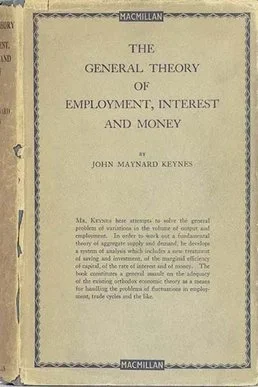
John Maynard Keynes
The General Theory of Employment, Interest and Money (first edition).
The assumption that underlies most decisions about website investment for service businesses is rarely examined. It goes roughly like this: the website is a necessary overhead, something you need to have, and therefore the most rational approach is to spend as little on it as possible while meeting the minimum threshold of acceptability. Find a template, customize it enough to look like yours, publish it, and redirect your investment toward the work that actually generates revenue.
This is a reasonable assumption on its face. It treats the website as infrastructure rather than as a business development tool, and it optimizes accordingly. The problem is that it is wrong in a way that is very difficult to see from the inside, because the cost of a website that underperforms is not a line item on a profit and loss statement. It is a collection of things that never happened. Clients who visited and quietly decided to look elsewhere. Referrals who checked the site before reaching out and did not. Opportunities that required a level of credibility the site did not communicate.
These absences are invisible. You cannot point to them. You cannot calculate them without knowing what they were. And so the assumption persists, because it is never directly contradicted by evidence the founder can see.
What ‘generic’ actually communicates
The word generic is worth examining before its implications for business can be understood clearly. In design, generic means a visual language that belongs to no one in particular, that could describe many businesses, that was assembled from available parts without an organizing point of view.
A generic website is not necessarily ugly. It can be clean, modern, and technically competent. The problem is not aesthetics in the narrow sense. The problem is that it communicates, at a pre-verbal level, something about how the person behind it thinks about quality and differentiation.
The psychologist Abraham Maslow observed that if all you have is a hammer, everything looks like a nail. In design, the equivalent is that if all you have is a template, everything looks like a template. The template imposes its logic on the content. The headings go where the template says headings go. The images are sized the way the template sizes images. The spacing reflects the designer who built the template's aesthetic sensibility, not yours. The result is a site that looks like the template with your name and services substituted in, which is exactly what it is.
What a prospective client experiences when she encounters this is not a conscious assessment of whether you used a template. It is a feeling, vague but persistent, that something is slightly off. That the site feels like it belongs to a category rather than to a specific person. That there is a gap between what you are claiming and what the site is demonstrating.
This feeling is not irrational, it is accurate. A site that was built without a genuine point of view about who it is for and what it needs to communicate does look like it belongs to a category rather than to a person. And a service business, which is asking a client to invest significant money in a relationship with a specific person, needs its online presence to communicate that there is a specific person there.
The trust problem
Trust in a professional service relationship is built on two foundations: competence and care. Competence is the belief that you can do what you claim to be able to do. Care is the belief that you are attending to the client's interests rather than merely your own.
Both of these foundations are communicated, before any words are read, by the quality and intention of the visual presentation. A site that demonstrates that someone has attended carefully to the details of how it looks and how it works is communicating care. A site that is visually inconsistent, structurally unclear, or obviously assembled from borrowed parts is communicating that the attention to detail stopped before it reached here.
This is the most direct cost of generic web design for a premium service business. It is not that the site looks amateurish. It is that it undermines the trust argument before the trust argument can be made. A prospective client who has to override a visual impression of carelessness in order to take your services seriously is doing extra work that she should not have to do. Many of them will not bother.
The trust problem is particularly acute for established founders at a premium price point because the stakes of the client's decision are higher. A founder charging $1,000 for a service is asking her prospective client to make a relatively low-risk bet. A founder charging $8,000 or $12,000 for a service is asking her client to make a significant financial commitment based on trust. The site needs to do proportionally more trust-building work, not less. And yet the instinct to minimize site investment tends to persist even as the price point rises, which creates a widening gap between what the service costs and what the site communicates about its value.
The price signal problem
There is a specific way that visual quality communicates pricing that most founders have not thought through explicitly, but that every prospective client experiences implicitly.
When a client is trying to determine whether a service is worth a significant investment, she is looking for signals that calibrate her sense of the appropriate price range. These signals come from multiple sources: the language used to describe the service, the testimonials and case studies presented, the biography of the founder, and the overall visual register of the site.
The visual register is doing more work than most founders realise. If the visual quality of the site is commensurate with a $500 service, the founder is starting every conversation about a $5,000 service from a credibility deficit. The client is not consciously thinking the site looks like a $500 service and therefore I will not pay $5,000. She is thinking something feels off about the price, without being able to locate why.
The Veblen effect, named for the economist Thorstein Veblen, describes the phenomenon in which certain goods become more desirable as their price increases because the price itself is a signal of quality. The inverse is also true: when signals of quality are absent, a high price feels implausible. A generic site is a quality signal that is working against the price, quietly and continuously, for as long as it is live. (Side note: Super interesting video about some of Veblen’s works here)
This is why the decision to save money on website design is more complex than it appears. The saving is real and immediate. The cost is invisible and distributed across every prospective client who visits the site and adjusts their perception of what your work is worth accordingly.
The compounding problem
One of the distinctive features of generic website costs is that they compound over time in a way that point-of-sale costs do not.
When you make a decision that saves money upfront but costs you revenue over time, the true cost of that decision is not fixed. It grows. Every month that a site which is underperforming on trust and price signalling is the primary representation of your business to cold prospective clients, the cost accumulates. And because the cost is invisible, there is no natural feedback loop that signals you to intervene.
A founder who has a generic site often knows, at some level, that it is not quite right. She hesitates before sending the URL. She adds caveats when directing people there. She feels a small deflation whenever she thinks about the site too directly. These are signals that the site is not working, but they are easy to suppress because the work of fixing it feels large and the immediate consequences of not fixing it feel abstract.
Meanwhile, the compounding continues. The right clients who are researching her find a site that does not match the level at which she is operating. Some of them move on. The ones who reach out in spite of the site are often not the right fit. The conversion rate on her highest-value offers stays lower than it should. And none of this is traceable to the site, because the people who did not reach out are not available to explain why.
The most expensive year for most founders with generic sites is not the year they built the site. It is the third and fourth year, when the site has been live long enough to have accumulated the credibility it never built, and the gap between where the business is and what the site communicates has widened to the point where the cost is genuinely substantial.
What the alternative actually requires
It is worth being specific about what the alternative to a generic site requires, because the common assumption is that it requires a large budget and a long timeline. Neither is necessarily true.
What a site that communicates premium positioning actually requires is a genuine point of view. Before any design decision is made, the site needs to know who it is for with specific enough clarity that every design choice can be evaluated against that knowledge. It needs to know what changes for the client after working with the person behind the site, described in the outcome language the client actually uses rather than the service language the founder uses. And it needs to know what the visual register of the business actually is, not borrowed from competitors or trend forecasts, but derived from the character of the work itself.
When those three things are clear, the design decisions that follow them are not arbitrary. They have a logic. The typography is not chosen because it looks sophisticated. It is chosen because it communicates the character of the work at the right level of precision and warmth. The palette is not chosen because it is on trend. It is chosen because it reflects the specific emotional register the client needs to feel when she lands on the site. The structure is not chosen because the template offered it. It is chosen because it guides the prospective client through the specific sequence of understanding that moves her from awareness to trust to action.
A site built from this kind of clarity does not need to be expensive in a financial sense. It needs to be intentional in a thinking sense. And intentionality cannot be purchased cheaply, not because the market will not offer it cheaply but because the thinking required to produce it cannot be shortcut. A designer who does not understand your work and your client cannot make the right choices even with a generous budget. A designer who does understand them will make choices that hold regardless of whether the budget is large or small.
The real question
The question most founders are asking when they decide how to approach their website is: how much do I need to spend to have something acceptable? This is the wrong question.
The question that serves the business is: what does this site need to communicate, to whom, and what is the cost of communicating it poorly?
“The typography is not chosen because it looks sophisticated. It is chosen because it communicates the character of the work at the right level of precision and warmth. The palette is not chosen because it is on trend. It is chosen because it reflects the specific emotional register the client needs to feel when she lands on the site. The structure is not chosen because the template offered it. It is chosen because it guides the prospective client through the specific sequence of understanding that moves her from awareness to trust to action.”
When the question is framed this way, the investment decision looks different. The cost of getting it right is not the designer's fee. It is the difference between a site that builds trust and converts the right clients at the right rates, and a site that undermines trust and attracts the wrong clients at lower rates or no clients at all.
That difference compounds over the life of the site. And it is almost always larger than the saving that motivated the original decision to go generic.
For Canadian women founders who are building service businesses at a premium level and want a website that reflects that, this page outlines how Gumptious approaches that work.
If you already know your site needs work and want to talk through it, get in touch here.