
The website design details that help you raise your rates
In 1928, Jan Tschichold published a book called Die Neue Typographie. He was twenty-six years old and had recently attended an exhibition of Bauhaus work that changed, permanently and irrevocably, how he understood the relationship between design and communication. The book argued for something that was, at the time, genuinely radical: that typography was not decoration applied to content but the primary means by which content communicated. The choice of typeface, the arrangement of elements on the page, the relationship between text and space, these were not aesthetic preferences. They were arguments. They carried meaning independently of the words they set.
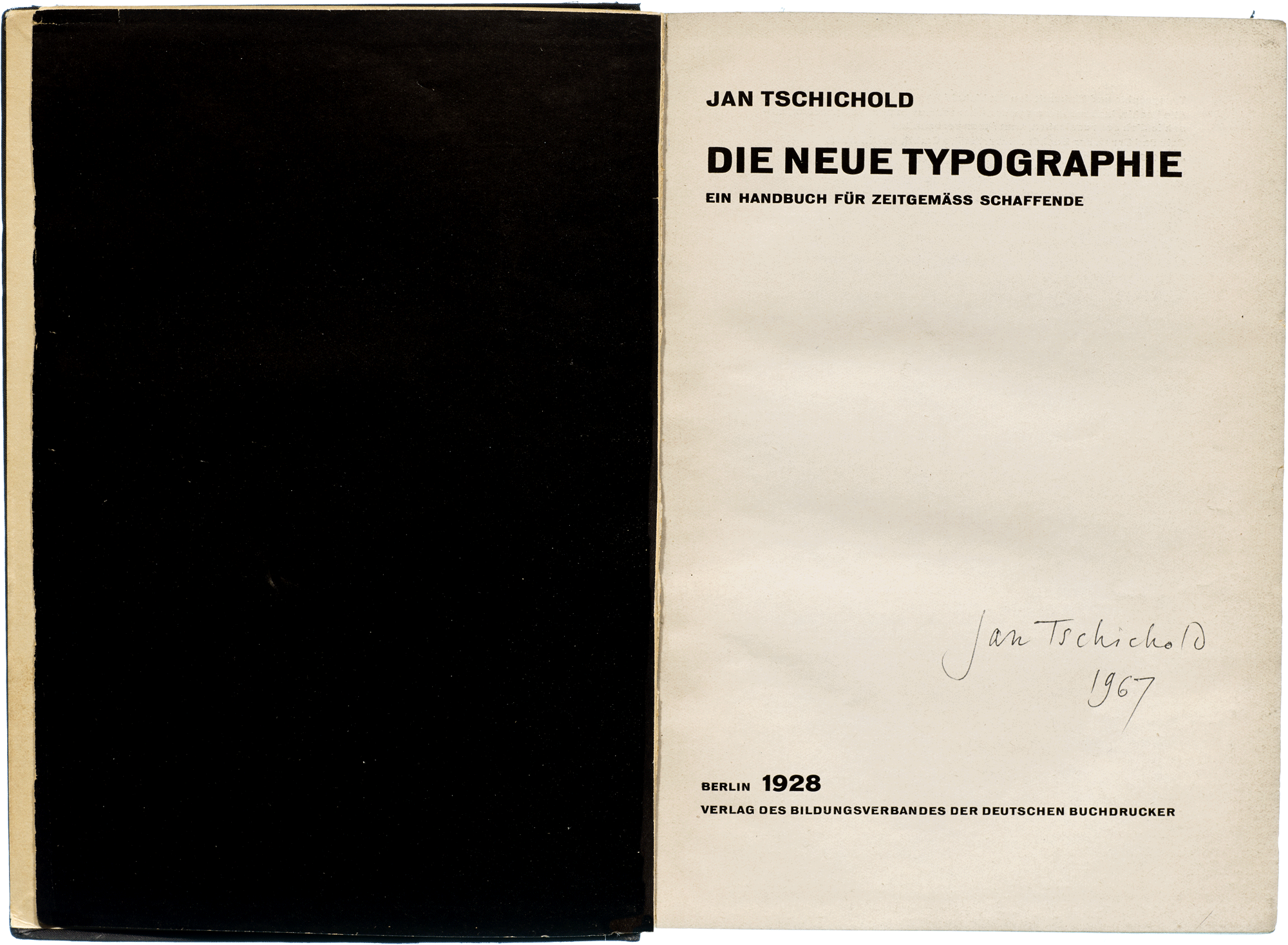
Tschichold spent the rest of his career refining this understanding. He moved from the modernist austerity of Die Neue Typographie toward something more humanist and classical, eventually redesigning Penguin Books' entire typographic system in the 1940s. But the core insight never changed: every typographic decision communicates something, whether or not the person who made it understood what they were saying.
This is the principle that most conversations about website design and pricing get backwards. The conversation usually goes: if you charge more, invest in better design. The real relationship runs in the opposite direction. The design is communicating your price point before you have named it. By the time a prospective client reads your pricing page, she has already formed a view about what your work is worth. That view was formed in the first seconds of her visit, by decisions you made about typography and spacing and colour and visual hierarchy that you may not have made consciously at all.
What design is actually communicating
There is a useful distinction in design between signal and noise. Signal is the information you intend to communicate. Noise is the unintended information that gets communicated alongside it, or instead of it, when the design is not working properly.
Most websites that underperform on pricing are not communicating nothing. They are communicating something unintended. The founder intends to communicate expertise, authority, and the value of her work. The design is communicating something else entirely, something about the level of care and intentionality that went into the presentation, which the prospective client reads as a proxy for the level of care and intentionality that will go into the service itself.
This is not a conscious calculation the prospective client is making. It is a rapid, largely pre-verbal assessment of coherence. Does this feel like someone who attends carefully to how things are put together? Does the visual register of what I am seeing match the professional level being claimed in the copy? Does the whole thing hold together in a way that communicates confidence rather than effort?
When those assessments come back negative, the prospective client does not think: this site has poor typography. She thinks: something feels off. And something feeling off is enough to introduce doubt, and doubt at the top of the funnel has a compounding effect on everything that follows.
Typography is the loudest signal
Tschichold was right. Typography communicates more than most founders realize, and it communicates before the text is read rather than through it.
The specific choices that matter most are not about which fonts are beautiful. They are about what the typographic system as a whole is saying about the person who designed it.
Consistency is the primary signal. A site that uses three different type sizes for body text across three different pages, or that has headings in one weight on the homepage and a different weight on the about page, is communicating that no one is attending carefully to the details. Inconsistency is not noticed consciously by most visitors. It is felt as a vague sense that something is slightly off, that the site was assembled rather than designed.
Hierarchy is the secondary signal. A page with no clear typographic hierarchy, where everything is roughly the same size and weight and therefore nothing is prioritized, communicates that the person behind the site does not have a clear point of view about what matters most. On a services page, this is particularly costly. If the outcome the client is buying is buried in the same visual weight as the delivery timeline and the refund policy, the site is not helping her understand what she is investing in.
Restraint is the tertiary signal. The number of typefaces in use communicates something about the design sensibility of the site's creator. A site using five different fonts is rarely making a sophisticated typographic argument. It is usually the result of accumulated decisions made without a unifying framework. Two fonts, used consistently and with purpose, communicate more authority than five fonts used eclectically.
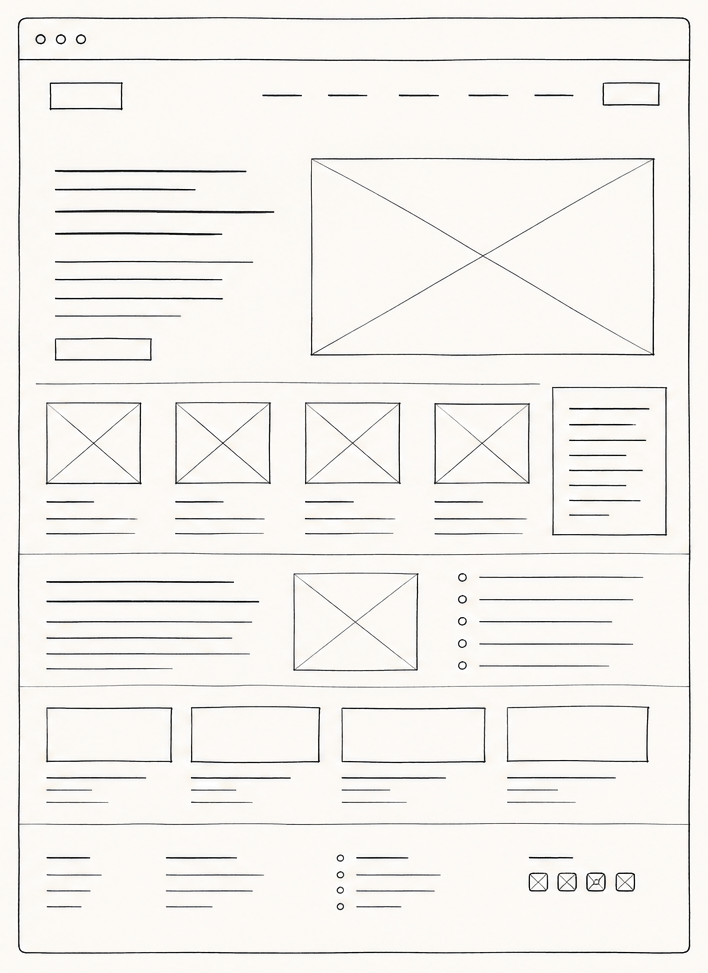
A cluttered web site design with no hierarchy, consistency or restraint communicates chaos and lacks credibility.
The Swiss typographers of the mid-twentieth century, Armin Hofmann, Josef Müller-Brockmann, Emil Ruder, understood this as the central discipline of graphic design. Their work was not minimal because minimalism was fashionable. It was minimal because they understood that every element added to a composition competes for the reader's attention, and that the designer's job is to eliminate that competition so that what matters can actually land.
Spacing is not emptiness
One of the most consistent differences between a site that reads as premium and one that does not is the use of space. Not the presence of space as an aesthetic choice but the understanding of space as an active design element that shapes how the content is perceived.
White space, or negative space, is the area of a composition that contains no element. In design, this space is not empty. It is working. It is establishing the visual weight of the elements it surrounds. It is creating the breathing room that allows a reader's eye to rest between points of engagement. It is communicating, at a pre-verbal level, that the person who designed this is not anxious about holding attention.
Crowded layouts communicate anxiety. The instinct to fill every available pixel with content comes from a reasonable concern: what if the visitor misses something important? But the effect is the opposite of what the founder intends. When everything is competing for attention, nothing receives it. The visitor feels overwhelmed rather than informed, and overwhelmed visitors leave.
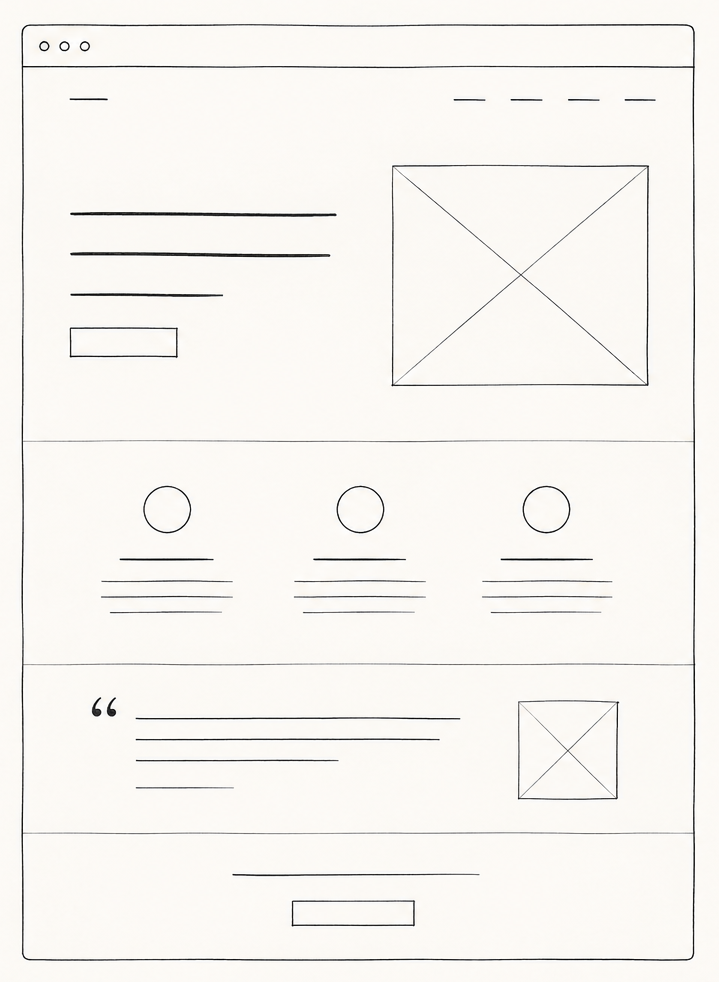
A considered web site design with hierarchy, restraint and generous white space reads as premium.
A layout that uses space generously communicates something different. It says: we are confident that what is here is sufficient. We are not trying to convince you with volume. We trust you to see what is worth seeing.
This is the same principle that governs the visual merchandising of high-end retail. A luxury boutique does not put everything it sells in the window. It puts one or two things, carefully chosen, in a great deal of space. The space is not wasted. It is the context that makes the objects readable as valuable.
Colour communicates before content
The psychological research on colour and perception is genuinely complex and often misrepresented in marketing writing. The simple claim that certain colours always communicate certain emotions is not well supported by the evidence. Colour perception is culturally contingent, context-dependent, and varies significantly between individuals.
What is better supported is the relationship between colour restraint and perceived quality. A palette with many competing colours at high saturation communicates visual noise. A palette with fewer colours, used with intentionality and consistency, communicates clarity. And clarity, in the context of a service business website, reads as competence.
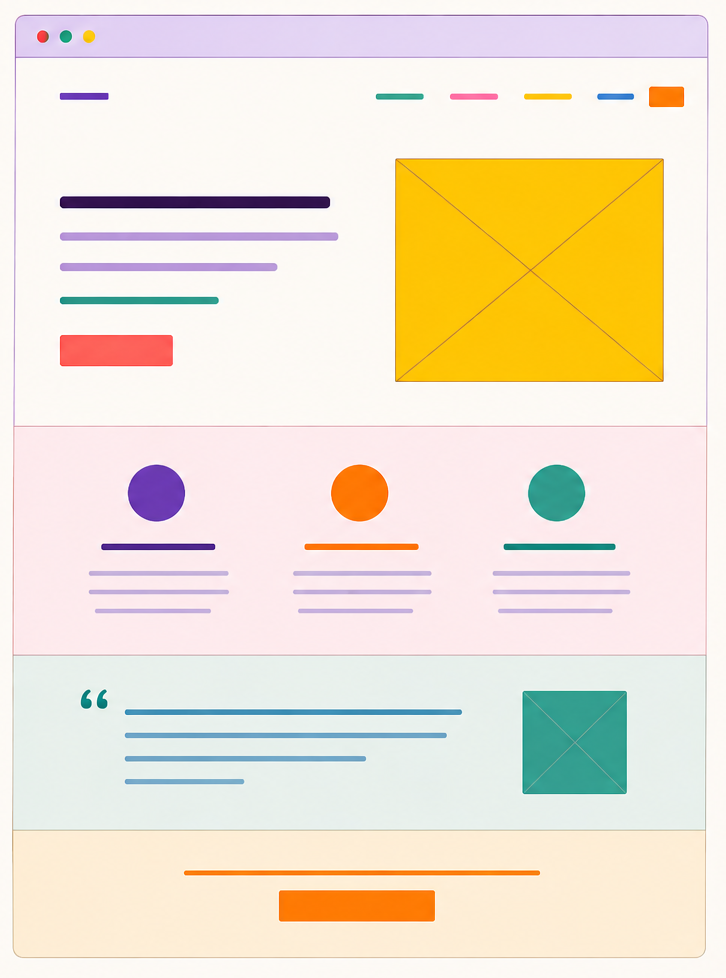
Unconsidered, scattered colour palette communicates a discount website
The specific colours matter less than their relationship to each other and to the overall visual system of the site. A palette of three colours used consistently across every page, in predictable and coherent relationships, creates the impression of a site that was thought through. A palette of six colours applied inconsistently, where the accent colour on the homepage is used as a background colour on the contact page, creates the impression of a site that was assembled in pieces by someone without an overview of the whole.
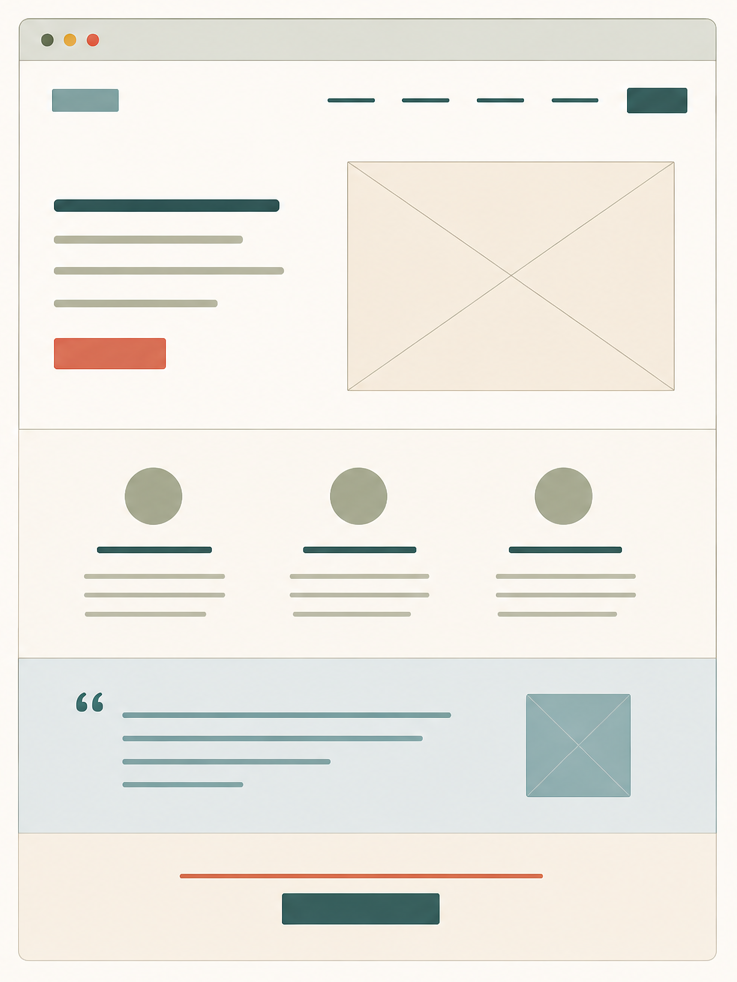
Uniform, deliberate colour palette communicates coherence that build credibility and trust
This is why the colour decision is never just a colour decision. It is a decision about the entire visual system and how rigorously that system will be maintained. A founder who chooses her palette carefully and then applies it inconsistently has not made a good colour decision. She has made a good colour choice and a poor design decision.
Photography is the proof of the claim
Every other design decision on a service business website is making a claim. The typography is claiming professionalism. The spacing is claiming confidence. The colour palette is claiming intentionality. Photography is where those claims either get confirmed or contradicted.
A site with sophisticated typography and generous spacing, paired with blurry or inconsistent photography, creates a jarring disconnect. The visitor experiences the gap between the claim and the evidence. That gap introduces doubt, and doubt undermines conversion.
This does not mean every founder needs an expensive professional photoshoot before she can have a site that works. It means the photography needs to be coherent with the visual register the rest of the site is establishing. A site that uses warm, candlelit, soft-focus photography throughout needs to maintain that register consistently. A site that introduces a bright, high-contrast image from a different context breaks the coherence and, with it, the impression of careful curation.
The specific quality level of photography that is required is proportional to the positioning of the business. A founder charging $500 for a service has more latitude. A founder charging $10,000 for a service is being evaluated at a level where the visual evidence of her own attention to quality is read as a direct indicator of the quality she will bring to the client's situation.
Layout is the argument
All of these elements, typography, spacing, colour, photography, operate within a layout that determines their relationship to each other and to the reader's movement through the page. Layout is where all the individual decisions either cohere into a single impression or fragment into competing signals.
The key principle in layout for service business websites is hierarchy. What does the visitor need to understand first, second, and third? That hierarchy should be visible in the visual weight of the elements: larger, heavier, and higher on the page for the most important information; smaller, lighter, and lower for the supporting details.
The failure mode most common in service business websites is a homepage that gives equal visual weight to too many things. The tagline and the testimonials and the service names and the about section blurb and the newsletter signup are all presented as roughly equally important. The visitor cannot locate the most important thing because nothing is signaled as the most important thing. She has to do the work of prioritising herself, and the cognitive effort required to do that is often enough to produce a bounce rather than a conversion.
A layout that makes the hierarchy clear removes that effort. The visitor's eye is guided, not by instruction but by visual logic, to the information in the order that serves her decision-making process. She understands what you do. She understands who it is for. She understands what happens next. Each of these in sequence, at the appropriate visual weight, without requiring her to work to extract them.
The relationship between design and rates
The reason these details matter for pricing is not that prospective clients are consciously evaluating your typography. It is that the cumulative effect of all these decisions produces an impression of the level at which you operate, and that impression shapes what she is prepared to pay before the number is ever mentioned.
A site in which every decision was made carefully and consistently, in which the typography is coherent, the spacing is generous, the colour palette is restrained, the photography is consistent, and the layout makes the hierarchy clear, communicates that the person behind it attends carefully to how things are put together. That attention is read, pre-verbally and rapidly, as a proxy for the attention she will bring to the client's situation.
This is why raising your rates and improving your design are not sequential activities. They are concurrent ones. The design is already communicating a price point. The question is whether the price point it is communicating is the one you are trying to charge.
When the design and the rate are aligned, the conversation about price is easier, not because the site says how much it costs, but because the site has already made the case for why it is worth it.
For Canadian women founders who are building service businesses at a premium level and want a website that reflects that, this page outlines how Gumptious approaches that work.
If you already know your site needs work and want to talk through it, get in touch here.
FAQs: Premium Website Design and Pricing
-
Clients make subconscious judgments based on design. Premium design builds trust, which supports higher rates.
text goes here
-
Restrained palettes with one or two anchor colors, balanced with white space, tend to feel elevated. Busy palettes often feel less credible.
-
Not necessarily. Consistency and hierarchy matter more than novelty. Many standard fonts can feel premium when used well.
-
Professional photography or even DIY photos taken with intention. Images influence perception more than almost anything else.