Why your brand strategy isn't working for you
You're capable. You have clients. You're doing the work. So why does something still feel slightly misaligned?
The problem no one names correctly
There is a particular kind of discomfort that shows up in the middle of building something. It is not failure, exactly. Your business is functioning, you have clients. Work is getting done. But something about the way you are showing up in it feels slightly off, like a sentence that is grammatically correct but somehow wrong in tone. You have workshopped your positioning statement, refined your elevator pitch, but still, when you say it out loud, something falls flat. The words describe the service but they do not capture the thing, the actual transformation you create, the particular way you see problems that no one else sees quite the same way.
If you have ever felt this, I want to offer you a different diagnosis than the one you have probably been giving yourself. Because the instinct, when something feels off in your business, is to assume the problem is execution. To think you just need to be clearer, more consistent, more strategic, more something. So you refine, iterate, try harder. And the misalignment persists, because you were solving for the wrong problem.
There is a design principle that explains this with unusual precision. It is called form follows function, and once you understand it not just as a rule for buildings and furniture but as a lens for how you show up in your work, the misalignment stops feeling like a personal failure and starts feeling like a design problem. Which means, crucially, that it has a design solution.
What Louis Sullivan actually meant
The phrase was coined by the American architect Louis Sullivan in 1896, and it is worth understanding what he was arguing against before you can fully appreciate what he was arguing for. Victorian architecture had a particular habit of covering buildings in decorative ornament that bore no relationship to what the building was actually for. Ornamentation as performance. Decoration as a way of signaling importance rather than expressing function.
Sullivan's argument was both simple and radical: the shape of something should emerge from its purpose. Not from what looks impressive, not from what is fashionable, not from what other buildings in the neighborhood happen to look like, but from what it actually needs to do. The form, in other words, should be the inevitable expression of the function, so completely that you cannot imagine them being separate.
Designers have been working with this principle ever since, and the easiest way to understand what it means in practice is to look at two very different chairs.
About two chairs: same object, completely different form.
The Eames lounge chair
In 1956, Charles and Ray Eames created one of the most iconic pieces of furniture in history for Herman Miller. Their brief to themselves was disarmingly simple: the chair should feel like a well-worn baseball glove. Warm, broken in, inviting, like something that already knows the shape of your body before you sit down.
Every detail of the final design serves that intention without exception. The seat angle reclines just enough that your body naturally decompresses when you settle into it. The back shell curves to support the lumbar spine with a precision that took dozens of prototypes to achieve. The leather is tufted so that it softens and molds to the body over time, becoming more itself the more it is used. The ottoman is proportioned so that your legs extend at exactly the angle that allows the rest of your body to fully release.
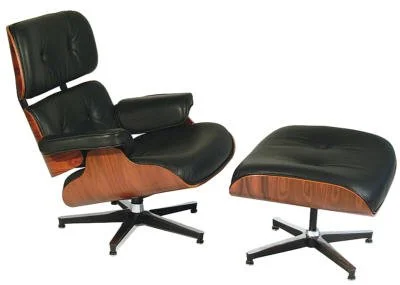
Nothing in the chair is decorative. Everything is functional, but the function is so completely realized that it stops feeling like engineering and starts feeling like inevitability.
This is what the best design does, and it is the part that is hardest to explain to people who have not spent time thinking about it. When a form follows its function completely, the design, or the effort of design disappears. You do not sit in an Eames lounge chair and think about the engineering decisions, the material testing, the iterations that came before the version you are sitting in; you simply sink in. The chair feels obvious, like it could not have been designed any other way, because the form and the function have become indistinguishable from one another.
The Coronation Chair
Now consider the Coronation Chair, built in 1300 and still used in British coronations today. It is also, technically, a chair. But it was designed for a completely different purpose, and that purpose is written into every single formal decision.
The function of the Coronation Chair is not comfort, and not ease. It is definitely not the feeling of a baseball glove. The function is the communication of authority, the embodiment of something larger and more permanent than the person sitting in it. Power made visible, history made physical.
And so the form is entirely different. It is tall, so that the person seated in it is elevated above everyone else in the room. It is rigid, because relaxation would undercut the gravitas the chair needs to communicate. It is elaborate in its ornamentation, because the decoration is not decoration in the Victorian sense Sullivan was arguing against. It is meaning and message. Every carved surface is saying something about lineage, permanence, and the weight of what is being asked of the person who sits there.
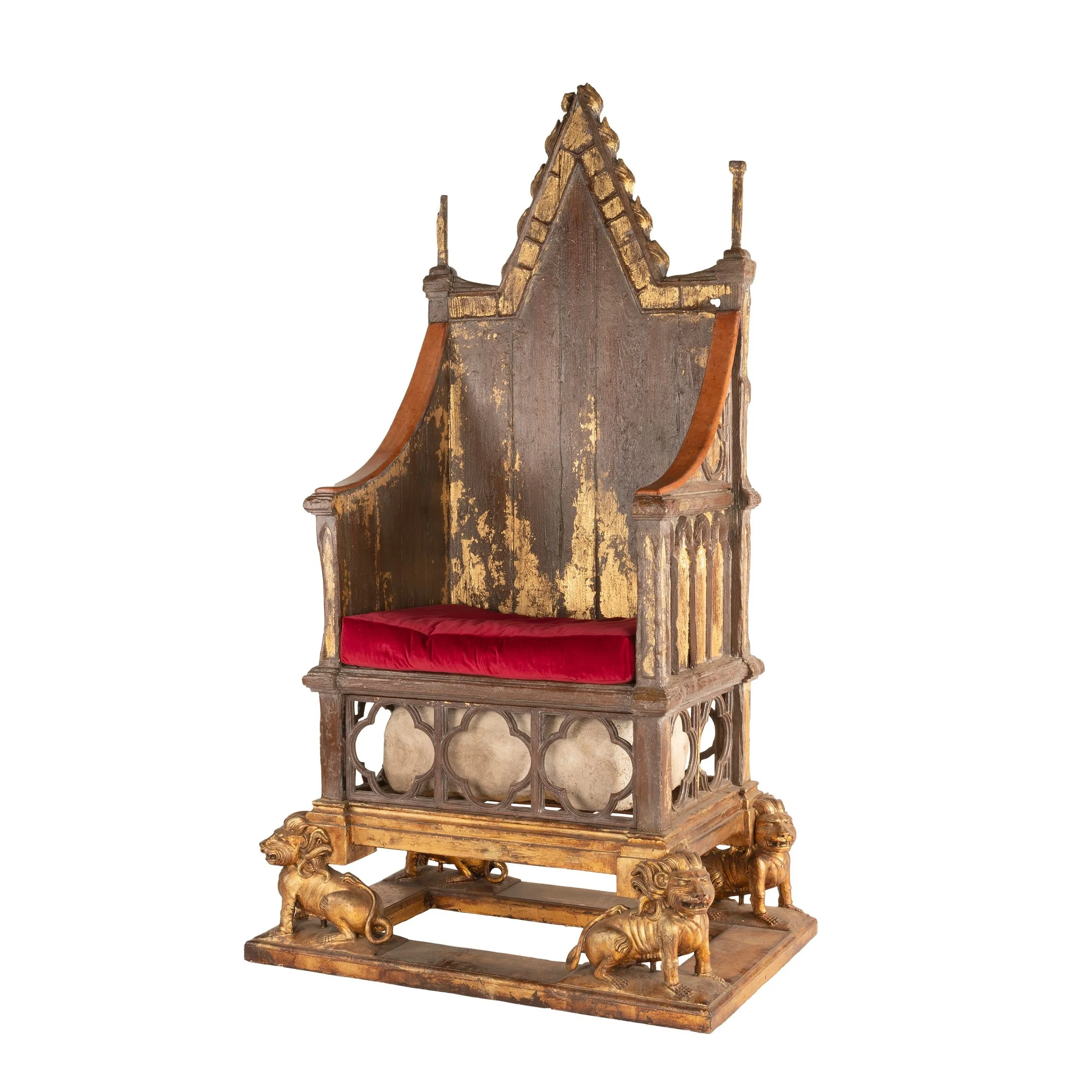
You are not supposed to sink into a Coronation Chair. You are supposed to project from it. Shakespeare, as always, understood this (and every other human emotion) instinctively. In Henry IV Part II, the king says “Uneasy lies the head that wears the crown,” and the Coronation Chair is the physical expression of that unease. Power has a posture, and that posture is deliberately, necessarily uncomfortable.
Two chairs, same object, completely different function, and therefore completely different form. And if you put someone in the wrong chair for their purpose, something feels off immediately. Perhaps not seemingly broken at first, but just misaligned in a way that is difficult to name but impossible to ignore.
Why this matters for your business
Most women building businesses spend an enormous amount of time thinking about form. What should the brand look like? How should the offer be packaged? What should the website say? What should the colours be, what photos should I use? What are other people in this space doing, and what can be learned from how they present themselves?
These are not bad questions. But they are second questions, and most people are asking them first, before they have answered the question that should precede all of them. The result is that they end up borrowing someone else's form, absorbing another person's vocabulary, structure, and aesthetic, and hoping it will fit their own function. Sometimes it works, partially. But often something still feels slightly off, because the form was designed for someone else's purpose and no amount of refinement can make it fit a function it was not built for.
The misalignment is not an execution problem. It is a sequencing problem (yes, this too is one of those!). The form came before the function was clear.
What designers actually do first
Here is what separates a designer's process from most people's intuition about how design works. Designers never start with form. Before a single line is drawn, a single color chosen, a single word written, a designer asks what this thing is actually for. What does it need to do? For whom? Under what conditions? What feeling should it produce? What action should it invite?
Only once the function is understood, deeply and specifically and honestly, does the form begin to emerge from that understanding. This is why Louis Sullivan's insight was not just about buildings. It was about the fundamental relationship between purpose and expression, the idea that when you know your purpose clearly enough, the expression of it becomes almost inevitable. The form, in a very real sense, designs itself.
The businesses that feel completely coherent, the ones where everything from the messaging to the pricing to the way the founder shows up in a room makes immediate, intuitive sense, were built this way. They started with function, they knew who they were for, what changed because of their work, and the specific, personal lens through which they created that change. And then they let the form follow.
The difference between a service and a function
This is where it becomes important to make a distinction that most business advice glosses over entirely: the difference between what you do and what you are for.
Your service is the deliverable, the thing you hand over at the end of an engagement. Your function is the transformation, the reason someone's life or business is different after working with you than it was before. And your lens, the specific way you see and solve problems that is particular to you and your history and your way of moving through the world, is what makes your version of that transformation different from anyone else's version of a similar service.
Most businesses are built around a service, a category, a title, a lane that already existed before you arrived in it. And those categories are forms. They were designed for someone else's function, and when you inhabit them without first understanding your own, you end up performing a category rather than expressing a purpose. The words feel borrowed because they are. The structure feels forced because it was built for someone else.
“Your service is the deliverable, the thing you hand over at the end of an engagement. Your function is the transformation, the reason someone’s life or business is different after working with you than it was before. And your lens, the specific way you see and solve problems that is particular to you and your history and your way of moving through the world, is what makes your version of that transformation different from anyone else’s version of a similar service.”
The businesses that feel right, the ones that attract the right clients and command the right prices and communicate something clear and true without apparent effort, are built around a function. They know, with unusual specificity, who they are for and what changes because of what they do and the particular lens through which they do it. When those three things are clear, the form has no choice but to follow. The right structure emerges, as if by itself. The right clients find you, because you are no longer performing a category. You are expressing a function.
What misalignment actually looks like
If you are not sure whether any of this applies to you, here are the most common signs that your form is not following your function.
You struggle to explain what you do in a way that feels true. You have a positioning statement, and maybe even an elevator pitch. But when you say it, something falls flat, and you find yourself over-explaining in an attempt to close the gap between what your words describe and what you actually do.
You attract clients who are not quite right. They want part of what you offer but not all of it. They are not quite the person you do your best work for, and you find yourself over-delivering and under-charging to compensate for a fit that was never quite there.
Your visual identity, your messaging, and your offers feel like they belong to three different businesses. They were each created at different times, in response to different pressures, and there is no unifying function holding them together into something coherent.
You feel like you have outgrown something but cannot name what it is. Your thinking has deepened. Your expertise has compounded. But the structure you built your business around was designed for an earlier version of you, and it does not quite hold who you have become.
“Instead of asking how you should package your offer, ask what transformation you are actually selling and what structure would be the most honest expression of how you deliver it. Instead of asking what everyone else is doing, ask what is distinctly yours, and what form would allow that thing to show up most completely.”
All of these are form problems. And they all have the same root cause: the form was built before the function was understood.
How to start asking the right questions
This is not a quick fix, and I want to be honest about that. But it does begin with a shift in the questions you ask yourself, and that shift is accessible to anyone willing to sit with some genuine discomfort.
Instead of asking what your brand should look like, ask what your brand needs to communicate, and to whom, and why that particular communication matters more than any other. Instead of asking how you should package your offer, ask what transformation you are actually selling and what structure would be the most honest expression of how you deliver it. Instead of asking what everyone else is doing, ask what is distinctly yours, and what form would allow that thing to show up most completely.
The function question is uncomfortable precisely because it requires honesty. It asks you to stop performing a category and start articulating something more personal and particular, something that cannot be borrowed from someone else because it came from you specifically. But that discomfort is where the clarity lives. And when form finally follows your function, when everything from your messaging to your offers to your visual identity was designed around what you actually do and who you actually serve, something shifts in the way your business moves through the world.
Things become easier to explain, and the right clients find you more easily. The direction becomes clearer, because the structure finally fits.
The bottom line
Form follows function is not just a design principle, it is a diagnostic tool for anyone who has ever felt that something in their business is slightly, persistently off in a way they cannot quite name.
The Eames lounge chair became what it is because every decision was made in service of a single, clearly understood function. The Coronation Chair communicates what it communicates for exactly the same reason. And the businesses that feel completely, unmistakably right were built the same way, from function first, with the form following as its natural and inevitable expression.
If you are ready to do that work, get in touch so we can start figuring out the function behind your form.